 Blog

Tabla de Contenidos
We have covered car rental from several angles on this blog, from the requirements to rent a car in Mexico to the questions travelers ask most. This time the subject is the one that catches many visitors off guard at the counter: the car rental deposit in Mexico, what it covers, how it is taken and when you get it back.
What is a car rental deposit in Mexico?

Every rental contract comes with a deposit. It is there to back up anything the rental company may have to charge once the car is back: traffic fines, repairs to the car, or the insurance deductible if there was an accident.
Even with full coverage, insurance policies have exclusions. Drive under the influence of alcohol or drugs and the repair bill is entirely yours. Towing, impound lots and traffic tickets aren’t covered either, which is why the deposit exists in the first place.
How the deposit is taken
Most rental companies only take the deposit on a credit card. A hold on a debit card freezes money that is already in your checking account, while a hold on a credit card only reduces your available credit.
There is a second reason: a debit hold usually takes longer to come off once the rental company cancels it. Cash deposits are rarely accepted, for the safety of both the customer and the company.

The agent takes the deposit on a regular card terminal, the same kind used for a sale, choosing a pre-authorization option instead of a charge. Once your bank approves it, the terminal prints a slip marked “check-in”, “contract opening” or something similar, along with the authorization number. Ask for your copy when you sign the contract and pick up the car.
At Veico, the rental terms are clear on this point: the deposit is a credit card pre-authorization, never cash or a bank transfer. The one exception is for customers with a U.S. or Canadian driver’s license, who may use a debit card issued by a U.S. or Canadian bank.
When do you get the deposit back?
Rental companies usually cancel the hold as soon as you return the car and they confirm it is in the same condition you received it.
Sometimes the deposit stays open after the return. That happens when there is a reasonable suspicion of hidden damage and the car needs a mechanical inspection to rule it out. A few companies keep every deposit open for days after the return, damage or not. Those are worth avoiding.
Even after the rental company cancels the hold, the bank that issued your card still needs time to release it. Veico’s terms put that at two to five business days in most cases, and it can stretch longer with some banks. Once the company has closed the deposit, there is little it can do to speed up the bank.
Keep in mind that a deposit release is not a refund. You won’t see a credit line on your statement, because nothing was ever charged; the hold simply disappears and your available credit goes back up.
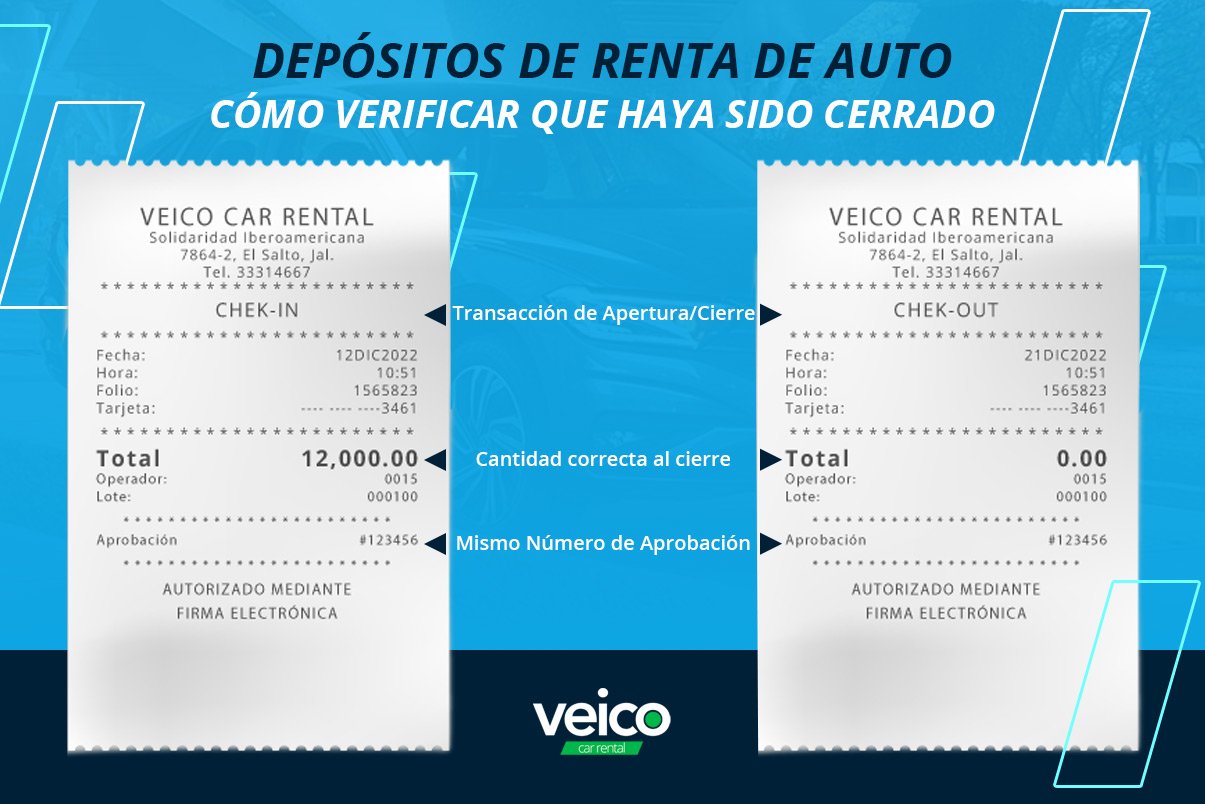
To make sure the rental company did its part, ask for the slip that closes the deposit. It should say “check-out”, “contract closing” or similar, show the right amount and carry the same authorization number as the slip you got at pickup.
How much is the car rental deposit in Mexico?
It depends. The rental company, the type of car, the protection you choose and even the rate you paid all affect the amount. The car type is the obvious factor; the price you paid is less obvious.
Some companies don’t have fixed deposits and raise them at will to push up the total cost. A very low rate often comes with a high deposit. The bait is a cheap daily price without protection for the car; at the counter, the agent pushes coverage that can cost more than the rental itself.
If you turn down that “optional” coverage, the deposit goes up, on the argument that the car is now unprotected. If your credit limit can’t handle the hold, the only way out is to buy the coverage, and the trip ends up costing far more than the quote.
Choosing the right company avoids all of that. For a car rental in Guadalajara, Veico’s published deposits go from MXN 12,000 (about USD 650) for economy and compact cars to MXN 18,000 (about USD 975) for SUVs and minivans, and MXN 24,000 (about USD 1,300) for hybrid minivans. The same table applies in Colima, León, Manzanillo, Mazatlán and Puerto Vallarta. For a car rental in Cancun the amounts are lower, from MXN 5,000 (about USD 270) to MXN 9,000 (about USD 485). Whichever company you pick, ask for the amount before you arrive, in writing if possible.
How to avoid the most common deposit problems

- Choose a company with a clear deposit policy.
- Find out the deposit amount when you book, not at the counter.
- Make sure your credit limit covers both the rental and the deposit.
- Read reviews of the companies you are considering. They tell you about deposits and also about car condition, pickup times and charges for pre-existing damage.
For more on what the rate includes and what it doesn’t, read our guides on unlimited mileage car rental, the collision damage waiver in Mexico and time and mileage rates.